

For decades, the technology industry has relied on a simple principle: make chips smaller, faster, and more powerful.
This strategy transformed society. It gave rise to personal computers, smartphones, cloud computing, and artificial intelligence. Every major digital innovation of the modern era has been built upon advances in semiconductor technology.
But as artificial intelligence continues to accelerate, the computing industry faces a challenge unlike anything it has encountered before.
AI systems require enormous computational resources. Training advanced models demands vast processing power, extensive memory capacity, and massive energy consumption. The infrastructure supporting these systems continues to grow larger, more expensive, and more complex.

At the same time, semiconductor manufacturers are confronting the physical realities of miniaturization. As transistors shrink to increasingly microscopic dimensions, further improvements become harder to achieve.
Many researchers believe the next chapter of computing will not come from refining existing technologies but from rethinking them entirely.
One company pursuing that vision is LongServing Technology.
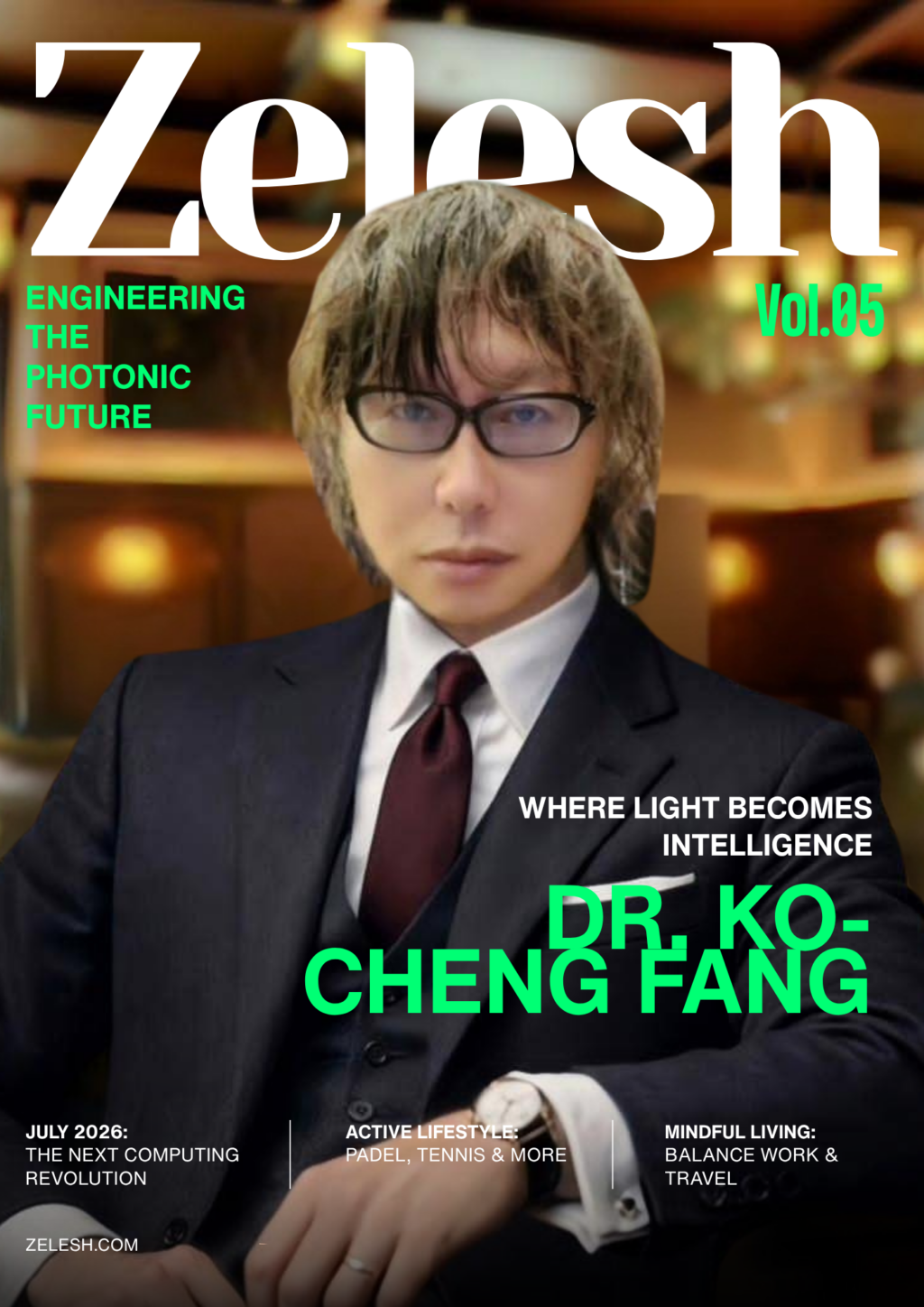
Led by Founder, CEO, and Chairman Dr. Ko-Cheng Fang, the company recently unveiled a photonic quantum chip architecture that seeks to challenge traditional assumptions about how computers should operate.
On April 23, 2026, LongServing Technology officially revealed a complete photonic computing framework, including a three-dimensional chip structure, a photonic signal transmission architecture, and a demonstration of a photonic full-adder design.
The announcement attracted attention because it represents more than a new chip design. It proposes a fundamentally different approach to processing information.
Instead of using electrical signals carried by electrons, the system is built around photons—particles of light.
The idea behind photonic computing is straightforward yet powerful.
Light travels faster than electrical current and generates significantly less heat. By using photons instead of electrons, future computing systems could potentially achieve greater speed, higher efficiency, and lower energy consumption.
For years, photonic computing has been viewed as one of the most promising candidates for next-generation computing. Yet despite its potential, practical implementation has proven difficult.
The challenge has never been understanding the advantages of light-based computation. The challenge has been building an architecture capable of making those advantages practical.
LongServing Technology’s newly unveiled design attempts to do exactly that.
At the center of the architecture is a three-layer system specifically designed for optical information processing.
The first layer functions as photonic memory, providing a location where optical information can be stored directly. The second layer contains photonic logic gates responsible for computational functions. The third layer serves as a photonic pathway network through which optical signals travel.

Together, these layers form an integrated framework intended to support large-scale optical computation.
The structure represents a departure from conventional semiconductor design.
Traditional electronic processors often require numerous fabrication layers to accommodate complex electrical circuitry. LongServing Technology believes photonic systems can achieve comparable or greater functionality through a more streamlined design.
One of the most distinctive elements of the architecture is its 45-degree optical routing strategy.
Conventional chips were designed around the behavior of electricity. Dr. Fang’s architecture instead focuses on the movement of photons.
By redesigning signal pathways around optical transmission, the company aims to improve efficiency while creating a structure better suited to photonic operations.
This philosophy reflects a broader shift in thinking.
Rather than adapting light to fit existing electronic architectures, LongServing Technology is building an architecture around the unique properties of light itself.
Another major innovation within the system is photonic memory.
Current computing environments frequently move information between optical and electronic formats. Data is transmitted through optical networks, converted into electrical signals for processing, and often converted again for communication.
Each conversion consumes energy and introduces inefficiencies.
Photonic memory seeks to reduce those inefficiencies by keeping information within an optical environment throughout much of the computational process.
According to Dr. Fang, this approach could significantly improve performance while reducing energy requirements.
The architecture is supported by another important innovation known as X-Photon.
One of the largest barriers facing photonic computing has historically been wavelength size. Traditional optical systems often operate at wavelengths much larger than the nanoscale dimensions used in modern semiconductor manufacturing.
To address this challenge, Dr. Fang developed X-Photon, a photonic quantum material capable of emitting light at approximately 2 nanometers.
This advancement could allow optical systems to operate at dimensions compatible with highly advanced chip fabrication technologies.
Smaller wavelengths enable denser optical pathways, making it possible to create compact photonic circuits capable of supporting sophisticated computational tasks.
The implications are far-reaching.
Artificial intelligence is becoming one of the largest consumers of computational resources in history. Future AI systems will require unprecedented levels of processing capability to support increasingly complex applications.
Photonic quantum computing could provide a pathway toward meeting those demands.
Potential applications include advanced AI systems, autonomous robotics, cloud infrastructure, telecommunications, aerospace technologies, scientific research, healthcare innovations, and next-generation industrial automation.
The technology may also help address growing concerns regarding sustainability.
Data centers currently consume vast amounts of energy and require extensive cooling infrastructure. Because photonic systems generate less heat, they could potentially reduce operational costs and improve energy efficiency across the computing industry.
As governments and corporations seek ways to balance technological growth with environmental responsibility, innovations that improve computational efficiency are becoming increasingly valuable.
For LongServing Technology, however, the project is about more than solving technical challenges.
It is about exploring what comes next.

Throughout history, major technological breakthroughs emerged when existing systems approached their limits. New ideas succeeded because they challenged accepted assumptions and introduced entirely new possibilities.
Today, artificial intelligence is pushing computing infrastructure to unprecedented levels.
Tomorrow’s solutions may require technologies that look fundamentally different from those of the past.
LongServing Technology’s photonic quantum chip architecture represents one such possibility.
It offers a vision of computing powered not by electrical current, but by light. A vision where speed, efficiency, and scalability are redefined through optical innovation.
Whether photonic quantum computing ultimately becomes the dominant technology of the future remains to be seen.
But with its latest announcement, LongServing Technology has made one thing clear: the search for the next generation of computing is no longer a distant concept—it is already underway.
Contact Information
Dr. Ko-Cheng Fang
Founder, CEO & Chairman
LongServing Technology Co., Ltd.
Email: service@longserving.com.tw
Website: https://longserving.com.tw/en/
Instagram: @ko_cheng_fang_david

